

25/12/2025
Category: Yacht charters

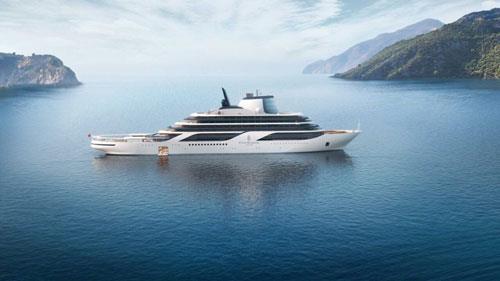
It had all the hallmarks of a high-end hotel, but none of the people behind the project use the word “cruise.” Four Seasons Yachts CEO Ben Trodd puts it plainly: this is a yacht. And a 207-meter superyacht, at that.
The insistence on wording is not a detail. It is a matter of substance. When was the last time that “cabin” meant an average of 54 square meters? Or that a bar had tables made of églomisé, made in London and specially designed by Martin Brudnizki Design Studio? Even the term “cabin” seems inappropriate. The 95 guest spaces, designed by Tillberg, function as full residential suites: spacious, with verandas, in some cases with plunge pools, and bathrooms lined with Brazilian quartzite in shades of sea and marble. The wall panels refer to anigre wood, but in fact it is a high-strength veneer, resistant to fire, scratches and UV.
The bookcases are not decorative details. They are curated with Assouline publications, with Prosper Assouline also playing an active role as the yacht’s creative director. And for those who don’t even settle for “extraordinary,” there’s the Funnel Suite: nearly 9,000 square feet, four levels, three bedrooms, and a stunning spiral staircase with mirrors, positioned at the top of the boat.
The public spaces bear the signature of Martin Brudnizki, in his first collaboration with a yacht. And this is where the real hard stuff begins. Unlike onshore projects, where designs evolve, in naval architecture, once approved, they’re locked in. There’s no second chance. Which explains why every choice seems so deliberate, almost immovable.
The aesthetic could easily fall into the trap of a nautical theme. It doesn’t. There are hints, like a 400-year-old marine fossil in a public space or Katherine Lloyd’s shell works in the Champagne & caviar bar on Deck 6. But nothing shouts. Everything operates underground, almost in whispers.
Even the swimming pool refuses to stay in place. Its bottom is raised and transformed into a flat surface for dining and events. Because apparently a simple swimming pool was not enough to convince someone that they were on board something different.
The intention, as Assouline puts it, was not to reproduce the past of the golden age of yachting, but to convey its spirit. “The idea was to recall a moment when yachting was associated with elegance, culture and discovery. Not to copy it, but to capture its spirit through objects, materials and works that seem collected, multi-layered and deeply personal,” he said characteristically.
The result is a world at sea that does not try to impress through exaggeration, as we have, let’s be honest, become accustomed to. It prefers to quietly convince that luxury is no longer in size, but in the control of every detail. And so, the Four Seasons manages to do something quite annoying for the competition: redefine the benchmark.

Main offices in Greece:
67 Posidonos Ave, 16674, Glyfada
2B Esperidon Sq., 16674, Glyfada
POBox 358
Athens - Greece
Tel. +30-210-968-0486
Mobile: +306974788888
WhatsUp: +306974788888
Viber: +306974788888
Email: info@alphayachting.com
Branch office in USA:
5497 Wiles Road, Suite 202
Coconut Creek, FL 33073
Tel. +1-954-234-2203
Email: info@alphayachting.com


 FAVORITES
 REVIEWS ALPHA YACHTING CHARTERS
 FAQS
FAQS